The books in the library are blank.
They have covers. They have titles. Open one and there is nothing inside. Outside, the grass is grey and the cherry pie is grey, and every road out of town loops back into town.
This is Pleasantville, a 1950s television sitcom. In Gary Ross’s 1998 film of the same name, two teenagers from the nineties, David and Jennifer, fall through their TV set and land inside it. Not in front of a black and white screen. Inside a black and white town. When they start telling their classmates the stories they remember from home, words begin to appear on the empty pages.
Bill Johnson runs the soda shop. He does the same things in the same order every day, until one day he cannot do them anymore. David shows him a book of modern art. Then Bill starts to paint.
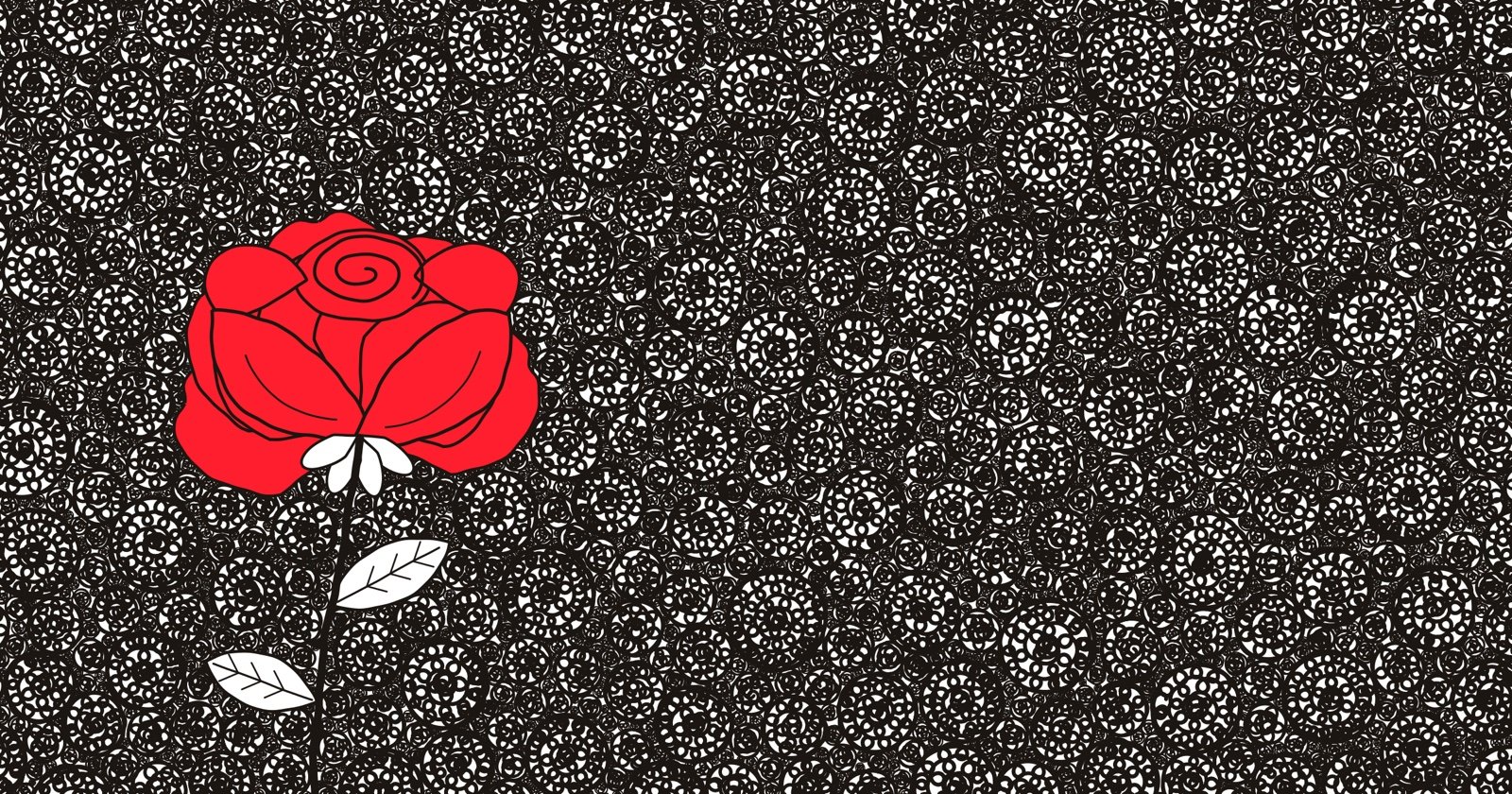
The first colour in Pleasantville is a single red rose. Then a blade of green grass. Then a face. Nobody in the film switches the colour on. It arrives in people one at a time, when they do something they actually want to do instead of what the script has always told them to do. By the end, Bill has painted a mural across the front of his shop, and the town council has made bright paint illegal.
That rose is the closest thing I have to an answer when someone asks me what taste is.
When every hand holds the same brush
I believe that as artificial intelligence gets better, we are heading back to a world where everything comes down to taste.
Picture it. Anyone can build an app in an afternoon. Anyone can make a song, a logo, a short film, a landing page. When the tool is in every hand, the tool stops telling us anything about the person holding it. The question that is left is much older than any software. What do you actually want? And can you tell what is excellent from what is merely fine?
I did not want to make that claim on feeling alone, so I went looking for evidence.
Two researchers, Anil Doshi at UCL and Oliver Hauser at the University of Exeter, tested this in a study published in Science Advances in July 2024. They asked 293 people to write short stories. Some wrote alone. Some were given story ideas by a large language model. Then 600 people read and rated the stories.
The stories written with AI help were rated more creative, better written and more enjoyable. The biggest boost went to the writers who were the least creative to begin with.
Then the researchers compared the stories with each other. The ones written with an AI idea were more alike. By their measure, about 10.7 percent more similar than the stories written by people working alone.
The title of the paper says it plainly: “Generative AI enhances individual creativity but reduces the collective diversity of novel content.”
Every single story got better. The town got greyer.
Two landing pages, one soul apart
Let me make it concrete.
Say a plumber needs a landing page. Today they can describe the business to an AI tool and have a clean, working page in ten minutes. It will look good. I mean that. There is nothing wrong with it, and the plumber should be proud of it.
Now give the same tool to someone who has been a designer for fifteen years. Someone who has spent their life looking at type, at spacing, at what makes a person trust a page in the first second. Their page will look different. It will not be because they pressed better buttons. It will be because of a thousand small decisions about what to keep and what to refuse.
The same is true of an artist who moves from paper to a tablet. The tablet does not take their style away. Their eye for what is beautiful came with them. It was never in the pencil.
This is why taste is built from the work you already do. It comes from the human thing you have been practising, often for years, before any tool arrived. The tool amplifies whatever you bring to it. If you bring the default, you get the default, beautifully rendered.
Grey in a world of colour
In Pleasantville, taste looks like colour arriving in a grey town. But the image works in reverse too.
When everything is black and white, taste is the colour being added. When everything is colour, and every app and every song is saturated and loud, taste might be the one frame of black and white. It is the move away from where everyone else is standing. It is contrast, and contrast needs a person to decide where it goes.
That is the battle I see coming. A battle of soul. Soul is not mechanical. It is what happens when one human makes something that another human recognises as true.
Even the machine builders speak of taste
This is not a new idea. What is new is who is saying it.
Steve Jobs put it bluntly in 1995, in an interview with the journalist Robert Cringely for the PBS series Triumph of the Nerds: “The only problem with Microsoft is they just have no taste.”
He was not talking about features. Microsoft had plenty of those.
The programmer and investor Paul Graham gave the word a whole essay, “Taste for Makers,” in 2002. He wrote that “we need good taste to make good things.”
Graham came back to the same word on X in February 2026. “In the AI age, taste will become even more important,” he wrote. And then: “When anyone can make anything, the big differentiator is what you choose to make.”
In the same month, Greg Brockman, the president of OpenAI, wrote on X: “Taste is a new core skill.” Fortune reported both posts on 27 February 2026, alongside a reply to Graham from Dane Knecht, the chief technology officer of Cloudflare: “Building is easy now. Knowing what to build, and what not to, is the hard part.”
These are the people building the tools. They know better than anyone what the tools can do. And they keep coming back to the one thing the tools do not decide for you.
The pull toward the middle
Not everyone agrees. Matt Shumer, the chief executive of OthersideAI, pushed back on X that same month: “I don’t see why ‘taste’ and direction are uniquely human, like many people say. If an AI can train on it, it can learn it.”
He may be right. I do not know what these systems will be able to do in five years, and I do not think anyone does.
Taste will stay human. I notice what happened in that study, where the machine made every story better and pulled all of them toward the middle, and I cannot ignore it. A tool trained on everything we have already made is very good at giving us the average of it. Taste has always been the decision to leave the average behind.
The eye on the other side of the screen
There is one more person in this story. The reader. The listener. The person scrolling past a thousand landing pages that all look alike.
They are the ones who will have to tell the slop from the real work. If we stop training our own eye, we lose the ability to notice the grey. Pleasantville needed a town council to ban paint. We will not need one. The default will do it quietly, one perfectly fine page at a time.
So how do you build taste? Do the work you love, closely and for a long time. Look at the best of it until you can feel why it is the best.
The tools are free now. Your eye is not.